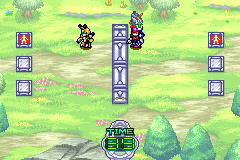
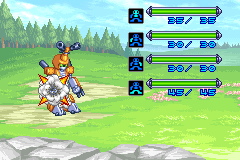
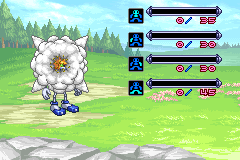
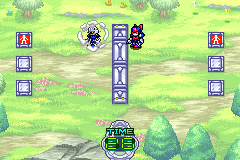
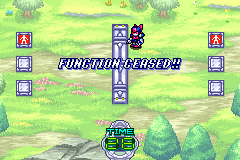
How the Robattle really works: the parts and medals you build with, the race to the action line, how hits, criticals and guards are decided, the Medaforce, and what you win. Every number here comes from the game itself.
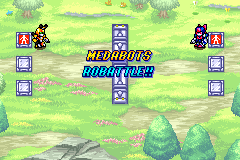
“MEDABOTS ROBATTLE!!”: every battle starts here.
What the game is
You play Ikki and his Medabot Metabee. Medabots are robots built from four parts (a head, two arms and legs) around a medal, the robot's mind. They fight in Robattles: teams of up to three per side, with the first Medabot on each team as its leader. Knock out the other leader and you win.
A Robattle isn't turn-based in the usual way. Every Medabot runs along a track towards the middle of the field while it prepares its action, acts when it reaches its line, then walks back home to choose again. Light, fast parts get you more actions; heavy weapons take longer. The Turns and speed page has the exact rule.
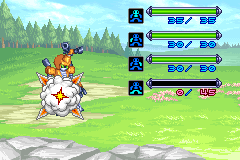
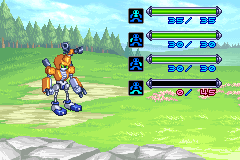
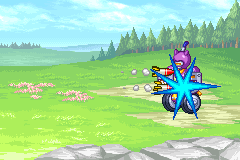
When an attack lands, the game cuts to a close-up of the two Medabots, plays the attack, and drains the armour of the part that was hit. A part at 0 armour is destroyed: it can't be used any more, and the Medabot shows its bare frame, the Tinpet, there. Lose the head and the Medabot is out.
The rules on this wiki come from a decompilation of the game: its code was turned back into readable form and each rule was checked by running it next to the original. Some things were only read from the code and haven't been watched in a battle yet. Each page marks which is which:
Checked ran in real battles, identical to the originalFrom the code read from the game's code, not yet watched or comparedWorked out arithmetic on the rules above, not a separate ruleUnknown not worked out yet
The pictures are the game's own: the Medabots' battle sprites and screens from real battles, made on your machine from your copy of the game. None of them, and none of the game's data, is part of this wiki's source. See Sources.
Start here
A Robattle, start to finish
Teams line up, everyone picks an action, and the race to the middle begins. The battle ends the moment a leader falls, or when TIME runs out.
Teams and leaders
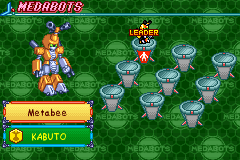
Each side fields up to three Medabots. The first Medabot on each team is its leader, marked LEADER on the screen before the battle.
After every action the game checks only the two leaders Checked:
If your leader has been knocked out, you lose.
Otherwise, if the other leader has been knocked out, you win.
Nothing else counts. Your team can keep fighting with its other two Medabots down, and you can win while losing them. Protecting your leader matters more than anything else.
A Medabot is knocked out when its head is destroyed. Broken arms and legs don't put it out of the battle.
Before the first story battle: Metabee, with the KABUTO medal, leads Ikki's team.
The opening
The field fades in and every Medabot on your team chooses its first action in turn (you can press B to go back to the previous one in this opening round). Then the “MEDABOTS ROBATTLE!!” banner appears, TIME comes up, and everyone sets off at once.
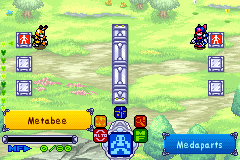
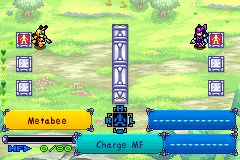
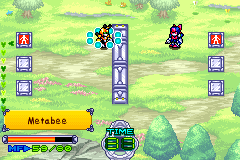
The command dial, with Metabee's name plate and MF gauge.The Medaparts screen: pick a part, or press down for Charge MF.Under way: each side's Medabots run towards the barrier.
The command dial
Whenever one of your Medabots is back home, the field stops and its command dial comes up. Turn it with left and right:
Command
What it does
Medaparts
Choose the head, right arm or left arm to use. The screen shows each part's name, attack type, skill, a head's uses left, why a part can't be used (broken, blocked, out of uses), and a marker on the Medabot it will hit. Down picks Charge MF instead, which fills the Medaforce gauge (“Medaforce gathered!”).
MF
Use one of the medal's three Medaforce moves (dashes for moves not learned yet), or Charge MF. See The Medaforce.
Status
A full screen with the Medabot drawn large, its medal and level, its four parts and their armour. R shows the other team, L comes back.
Aim
Tells you which Medabots this medal prefers to target, by its favourite attack type, e.g. “Targets Medabots who are equipped with "Strike" parts.” See Medals.
Rotation
Set up an eight-step action pattern with a “Repetition” point: your version of the patterns opponents follow (How opponents choose).
Auto
The Medabot chooses for itself from now on.
What each key does inside the Status and Rotation screens hasn't been mapped yet Unknown.
Acting at the line
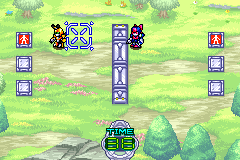
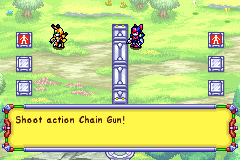
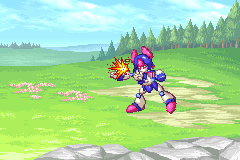
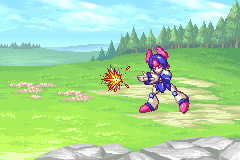
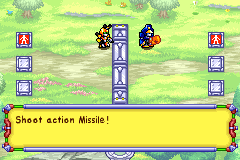
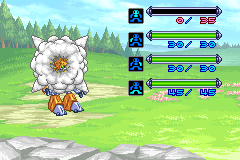
When a Medabot reaches its action line it acts. A flash marks it; a targeting reticle flies to its target; the text box names the attack (“Shoot action Chain Gun!”, the attack type then the skill). Then the game cuts to the close-up: black bars close in, the two Medabots appear large, the attack plays, and a panel shows the target's four parts and drains the armour of the one hit. If the part can't act (broken, sealed, out of uses), a mark appears over the Medabot and a message says why.
The reticle travels to the target.“Shoot action Chain Gun!”: attack type, then skill.The close-up: Brass opens fire.The damage panel: the target's four parts and their armour.
TIME
TIME starts at 40 seconds, or 30 or 20 if you change the Robattle time option (always 40 in a link battle) Checked. It counts down one TIME second every 32 frames, which is a little over half a real second: a 40-second battle lasts about 21 real seconds of running time Worked out. TIME stands still while an attack's close-up plays.
If TIME runs out with both leaders standing, the game judges the battle From the code:
the team with fewer Medabots knocked out wins;
if that's a tie, the team with fewer destroyed parts;
then the team that landed more hits (every hit a team's attacks land counts one);
a complete tie is a coin flip.
“Time's Up! The winner is …” follows. This has been read from the code but not yet watched in a battle.
Knockouts and the end
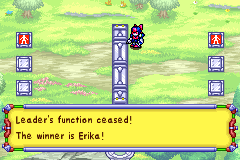
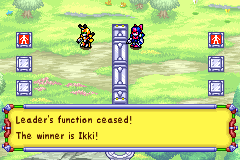
A knocked-out Medabot explodes on the field and is taken out of the battle, along with its status effects. If it was a leader, “FUNCTION CEASED!!” comes up and the battle is over: “Leader's function ceased! The winner is …”.
Metabee's head reaches 0 armour.Back on the field, the knocked-out Medabot explodes.A leader is out: “FUNCTION CEASED!!”Metabee was Ikki's leader, so this first story battle is lost.
Getting better as you fight
Each time one of your Medabots acts with a part or a Medaforce move, the game counts a use of that attack type. Every 8 uses, its success with that attack type goes up by 1, to at most 100 From the code. A sprite for the attack type shows when it happens. Medals at level 100 don't grow this way, and nothing grows in link battles.
Random encounters
Story battles are fixed. Random encounters choose among the current area's four battles with a roll from 0 to 100 Checked:
Unless the battle fixes them, each enemy's head, arms and legs are then re-rolled from four candidate parts with the same 40 / 30 / 20 / 10 odds, so the same opponent can show up with mixed parts.
Start here
Turns and speed
There are no turns. Every Medabot races along the battle track, and the fastest act most. Speed is a single number, the delay, worked out again every frame.
The battle track
Each Medabot starts at its side's home and moves towards the middle while it charges the action it chose. When it reaches its action line it joins a queue, and Medabots act in the order they arrive. After acting it cools down, walking back home facing away from the fight, and chooses again when it gets there Checked.
From home to the line is 64 pixels each way. While a Medabot walks home it is facing away, which matters for a few skills (Destroy only hits a Medabot facing away).
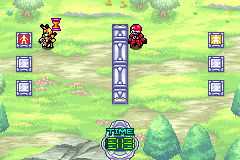
The barrier down the middle; the boxes down each side show each Medabot's leg type.
How far a Medabot moves
Every frame a Medabot moves (32 − delay) ÷ 16 pixels; fractions carry over to the next frame Checked. A delay of 0 moves 2 pixels a frame, the fastest possible; the slowest, 31, moves a sixteenth of a pixel.
The delay
The delay starts at 0 every frame and goes through these steps, in this order Checked:
for each intact head or arm with the Accel Chrg skill
Additions stop at 255 and subtractions at 0, step by step, and the total is then capped at 31. A destroyed part chosen for the action adds nothing. Divisions round down.
What it means. Level and propulsion are the only things that always make you faster, and both are small: a level-50 medal takes off 5, legs with 60 propulsion take off 3. Arm charge and cooldown times, and the terrain, usually matter more. Heads are a fixed +6 either way.
How long a trip takes Worked out
Putting the two rules together, a 64-pixel trip takes 1,024 ÷ (32 − delay) frames, rounded up. At 32 frames to a TIME second:
Speed calculator Worked out
Skills that change the race
Rapid Chrg: the next time the Medabots move, that one ally alone runs to its line at delay 8 while everyone else waits.
Boost Chrg and the Charge Medaforce move: a helpful status that takes its strength off the delay.
Drain Chrg: slows the target and speeds up its user, by the same strength.
Bind (from Wave and Hold attacks): adds its strength to the delay.
Pushover and Full Body RAD: knock opponents over or turn them round, so they lose the action they were charging.
Your Medabots
Parts
A Medabot is four parts: head, right arm, left arm and legs. Each Medabot model comes with its own four, but you can mix them freely.
Armour and breaking
Every part has armour, starting full at each battle. Damage comes off one part at a time. A part at 0 armour is destroyed: it can't be used, its skill stops working, and the Medabot shows its bare frame, the Tinpet, in its place (a male or female Tinpet, depending on the head) Checked.
Head destroyed: the Medabot is knocked out.
Legs destroyed: the leg stats are halved, and the Medabot is slower (+6 delay).
An arm destroyed: that arm can't be used.
Metabee's legs reach 0……and the Tinpet's legs show.
What each part does
Head
An action, like an arm, but with a limited number of uses per battle. Using it adds a fixed 6 to the delay. Losing it ends the Medabot's battle.
Right arm
An action with unlimited uses. Its charge time slows the Medabot on the way to the line, its cooldown time on the way back.
Left arm
The same as the right arm. Which arm gets hit is random, so it's worth spreading your best attacks.
Legs
No action. Five stats instead: propulsion, evasion, defence, fighting success and shooting success, plus the leg type.
Heads and arms have a skill (what using it does: see Skills), an attack type, success (accuracy) and power (damage). A few more numbers sit behind each part:
Carry-over: some heads and arms let damage that breaks a part carry on into another part Checked.
Damage divisor: the damage is divided by it; almost every part has 1.
Experience: what the part is worth to whoever beats it (Rewards).
Price: what the part costs.
Attack types
Every head and arm has one of eight attack types. The first four are attacks; types are either fighting or shooting, which decides which leg stat helps their success and which power bonus they get Checked.
Sword and hammer parts are Strike or Berserk; guns and missiles are Shoot or Aim Shot.
The set bonus
Every medal has a set bonus. A Medabot gets it once for each of its four parts that comes from its own set, and it adds to the Medabot's success and to its evasion and guard rolls. A full matching set gets it four times Checked.
Every head and arm
Every pair of legs
Your Medabots
Medabots and the builder
All 120 Medabot models as they look in battle, each built from its four parts. Pick one to see its parts, or mix parts in the builder.
Builder
Choose any head, arms and legs. The sprite is put together the way the battle screen places the four pieces; tick a part as broken to see the Tinpet underneath. Speeds use the rules on Turns and speedWorked out.
Every model
Your Medabots
Legs and terrain
Legs carry no attack, but they're in every calculation: how fast you move, how well you hit, and how well you dodge and guard.
The five leg stats
Stat
What it does
Propulsion
Speed: takes propulsion ÷ 20 off the delay. Half of it is also added to the damage of Berserk attacks.
Evasion
Added to the target's value in an evasion roll.
Defence
Added to the target's value in a guard roll.
Fighting success
Added to the success of Strike, Berserk, Defend and Heal parts.
Shooting success
Added to the success of Shoot, Aim Shot, Support and Interrupt parts.
All five are halved when the legs are destroyed From the code.
Leg types
Every pair of legs has one of seven types. Two of them can be targeted: Anti-Air parts prefer Air (flying) Medabots and Anti-Sea parts prefer Sea (swimming) ones. Against those leg types they get 16 times the part's success added to their success Checked. The Type Crash Medaforce move looks for an opponent with the same leg type as its user.
Terrain
Each Robattle is fought on one of eleven fields. Every leg type has a speed penalty on each, added to the delay (lower is faster; 0 is no penalty) Checked. Every leg type has fields it's good on:
Field names are the game's own. The eleventh field's name reads “saibar” in the game's data.
Your Medabots
Medals
The medal is the Medabot's mind. It sets how well the Medabot uses each attack type, which opponents it goes after, its set bonus, and its Medaforce moves, and it's the part that levels up.
What a medal decides
Medal type: one success value for each of the eight attack types, added to the success of every action of that type.
Favourite attack type: parts aim at opponents that have an intact part of this type. This is what the Aim command tells you.
Level: speeds the Medabot up (level ÷ 10 off the delay), adds to its evasion and guard rolls, and unlocks Medaforce moves.
Three Medaforce moves, learned at medal levels 10, 30 and 60 (“Medal mastered Medaforce …”).
After the battle: “"KABUTO" Medal has leveled up!”
Levels and experience
A medal's experience to its next level counts down as it earns experience. When it runs out the medal goes up a level and needs (new level + 1) × 100 more. Anything left over is lost, so one big win never gives two levels From the code.
Its rank is how many of its four rank levels it has reached (listed in the table below; 255 can't be reached).
How strong enemy medals are
An opponent's success for each attack type is its medal type's base success × (level ÷ 2), kept between 1 and 100. At levels 0 and 1 the base is used as it is Checked. Your own medals go through one more setup step that hasn't been mapped yet Unknown.
Every medal
Two medals are named just “?” and “!” in the game's data. Medals that share a type (the last four) also share their success values.
Fighting
Hitting and damage
Every attack goes through the same steps: the attacker's success, the target's roll to dodge or guard, a check for a critical, which part is hit, and the damage.
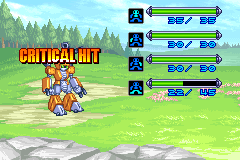
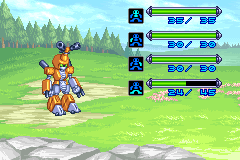
An Aim Shot from Brass's rifle……lands as a CRITICAL HIT.The legs' armour drains a point a frame.
1. Success
The attacker's success is the sum of Checked:
success = the part's success
+ set bonus × parts from the Medabot's own set
+ a random number from 0 to 7
+ the medal's success for the part's attack type
+ the legs' fighting success (fighting attacks)
or shooting success (shooting attacks)
+ the success of every intact part with the Strengthen skill
Then, depending on the attack: the part's success again if it doubles success (Break and Press, or the Gravity Form status); 16 × the part's success for Anti-Air or Anti-Sea against their leg types; the team's bonus from Scout; minus the Movement status and the target's Conceal penalty. It never goes below 0.
2. The target's roll
The target answers with an evasion roll or a guard roll (the attack decides which). Both start from the same value Checked:
target value = level + set bonus + a random number from 0 to 7
+ the legs' evasion (evasion roll)
or the legs' defence (guard roll)
− 8 (never below 0)
Critical hit
If the attacker's success is more than the target value multiplied by 2 for Aim Shot, 4 for Strike, or 8 for every other type, the attack is a critical: the target can neither dodge nor guard, and its value counts as 0 Checked. Aim Shot crits far more easily than anything else. Two skills, against two particular leg types, only need to beat the target value itself.
Evasion
Otherwise, on an evasion roll, the target value comes off the success. If nothing is left, the attack misses, unless it can't miss (Missile and Napalm parts, or the Bomb Form status). What's left becomes the basis of the damage.
Guarding
On a guard roll, a target value over 31 means the target guards: the value comes off the success. How the guard then plays out isn't fully mapped yet Unknown; on screen, a guarded hit can land on a different part.
Openings
Attacking leaves you exposed until you act again: after a Strike or Berserk attack you can't guard, after Berserk or Aim Shot you can't evade. A target that can do neither only gets the critical check. The Stop, Can't Evade and Can't Defend statuses do the same.
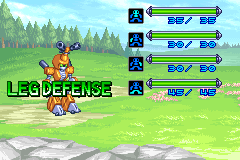
“LEG DEFENSE” rises over Metabee before the damage. What exactly it marks hasn't been worked out Unknown.
3. Which part is hit
The part hit is random, from a table with one row for each combination of intact parts. A random number from 0 to 7 picks one of eight entries, so the odds are in eighths. Broken parts drop out of the odds Checked:
With everything intact, the legs are hit most often and the head least. Parts that aim (like guns preferring a favourite target) use the same odds. Heal and repair skills pick their own part.
4. Damage
damage = what's left of the success ÷ 4
+ the part's power + the Medabot's power bonus
+ its fighting power bonus (Strike, Berserk)
or shooting power bonus (Shoot, Aim Shot)
+ the legs' propulsion ÷ 2 (Berserk only)
+ the part's power again (Laser and Beam, and again with Optic Form)
+ a bonus from the target's position (one particular skill)
+ the power of every intact Strengthen part
− the target's defence (never below 0)
if damage < 3: damage + a random number from 0 to 3
then: damage ÷ the part's damage divisor
All divisions round down Checked. The minimum chip means even a weak hit does something. Defence here is the Medabot's own defence value (raised by Iron Wall), not the legs' defence stat, which only helps the guard roll.
Damage to parts
If the damage is less than the part's armour, the part takes all of it. Otherwise the part takes exactly what armour it has left and is destroyed, and the rest is overflow. Overflow carries on to another random part only when the attacking part has carry-over, or the attacker has the Bomb Form status (which adds 10 to it each time). It keeps going until nothing is left Checked.
Every hit also fills the target's Medaforce gauge by 20 (The Medaforce).
Damage calculator
Pick the parts and medals, or type the numbers. The calculator goes through every pair of random rolls (64 combinations) and the minimum chip, so the odds are exact for the rules above Worked out.
Fighting
Skills
A part's skill is what using it does. There are 60: plain attacks, attacks with an extra effect, special actions, and passive skills that work just by being intact.
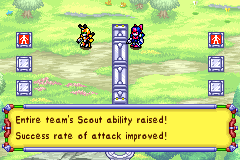
Brass's head uses Scout: “Entire team's Scout ability raised!”An attack with an effect: Hold, which also binds.
The attack plus something of their own: a status, a trap, a push.
Special
17
No attack: repairs, revives, team effects, stealing.
Passive
5
Can't be used. CancelOptic, CancelBomb, CancelGrav, Accel Chrg and Strengthen work just by being intact.
Boosts and the parts that cancel them
Six attacking skills come in pairs with a boost. Three passive skills on the target each cancel one of them, and three pairs of Medaforce moves give the same boost, or the same protection, as a status Checked:
Boost
From skills
Or the status from
Cancelled by passive
Or the status from
power counts twice
Laser, Beam
Optic Form
CancelOptic
Absorb Optic
never misses
Missile, Napalm
Bomb Form
CancelBomb
Absorb Bomb
success counts twice
Break, Press
Gravity Form
CancelGrav
Absorb Gravity
Who a skill targets
When a Medabot chooses its action, every part's target is worked out in advance, so choosing a part also chooses whom it hits From the code.
Guns, lasers, missiles and the like (Rifle to Press), Pushover, Sacrifice and TeamAttack go for opponents with an intact part of the medal's favourite attack type.
Swords, hammers, status attacks and Destroy choose no target in advance: they hit the opponent furthest along the track, the one closest to the middle.
Anti-Air and Anti-Sea prefer flying (Air) or swimming (Sea) opponents with a favourite part, then any flying or swimming one, then a favourite.
Support skills pick an ally that needs them: Recovery the one with a damaged part (aiming at the most damaged), Repair one with a destroyed part, Reactivate a knocked-out ally, Stability one with a harmful status.
Harmful skills (Drain Chrg, Impair, Confusion, No Escape, No Defense) pick an opponent that has no harmful status yet and no Stability part.
If nobody fits, the conditions are relaxed step by step until any Medabot on that side will do. A Medabot under Chaos hits a random Medabot other than itself, allies included.
When a skill can't be used
A part can't be used when a status has sealed it, when it's a head with no uses left, when it's destroyed, or when its skill says no From the code. The skill's own conditions:
Skills
Can't be used when
Defence, Full Block, Half Block
fewer than two of its team are still in the battle
Grap Trap / Shot Trap
no opponent has an intact Strike or Berserk / Shoot or Aim Shot part
Break Form
there's no trap on its own team
Stability
the target has no harmful status
Recovery / Repair / Reactivate
the target part is undamaged or destroyed / isn't destroyed / the target isn't knocked out
AutoRecover, Boost Chrg
the target already has a helpful status, or a Stability part
Drain Chrg, Impair, Confusion, No Escape, No Defense
the target already has a harmful status, or a Stability part
Rapid Chrg
its target is itself
Use Drain / Forcedrain
the target's head has no uses left / the target has no Medaforce
Team Form / TeamAttack
nobody on its team has an intact TeamAttack part / Team Form hasn't been set
How strong a special skill is
Most special skills first work out a success value like an attack's (part, set bonus, random 0–7, the medal's success for the type, the legs' success), minus the Movement status, then take 32 off. At 0 the skill fails: “Action failed!”. From what's left From the code:
strength = (value ÷ 4 + the part's power) ÷ the part's damage divisor (at least 1)
a status it gives lasts "value" (1–99) and hits with "strength" (1–99)
A special skill that works counts as a hit for its team (which matters if TIME runs out).
Every skill
Fighting
Status effects
A Medabot can carry one helpful and one harmful status at a time. They wear off with TIME.
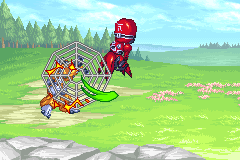
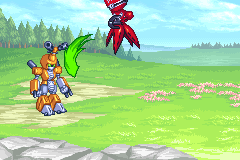
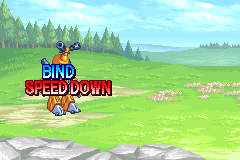
A status attack: “Strike action Hold!”It lands: “STATUS EFFECT”.Hold gives Bind: “SPEED DOWN”.Back on the field, the status shows over Metabee.
How long they last
Each status has a time left and a strength. Once per TIME second, the time left drops by 4; at 0 the status ends From the code. A status attack sets the time from its success, and the strength from its damage. A special skill uses its value and strength (Skills), each from 1 to 99, so a status lasts at most about 25 TIME seconds Worked out.
A status attack only gives its status if the attack hit, and the target's head still works. Statuses can't land on a Medabot with an intact Stability part, or on a team made immune by a Cancel Medaforce move.
Every status
Status
From
Effect
Strength
Movement
Bug, Virus
the Medabot's success is lowered by the strength
damage × 2
Stop
Thunder, Freeze
can't evade or guard; lasts damage ÷ 8
none
Bind
Wave, Hold
slower: the strength is added to its delay
damage ÷ 4
Flow
Fire, Melt
every TIME second the hit part loses the strength in armour, then the next parts, but never below 1
damage ÷ 2
Slowed
Drain Chrg
slower, like Bind
its strength
Can't Use
Impair, the Useless move
one part can't be used
Chaos
Confusion, the Chaos move
chooses its own action (you get no menu), and its attacks can hit anyone, allies included
Can't Evade
No Escape
can't evade
Can't Defend
No Defense
can't guard
Continuous Repair (helpful)
AutoRecover
every TIME second the first damaged part gains the strength in armour, then the next
its strength
Faster (helpful)
Boost Chrg, Drain Chrg's user, the Charge move
the strength comes off its delay
its strength
The names Movement, Stop, Bind and Flow are the game's own; which attacks give which was read from the code. Stability clears a harmful status from an ally; Status Restore clears the whole team's.
Fighting
Guarding and counterattacks
Some parts don't attack at all: they take a stance, either to step in front of an attack on a teammate or to throw an attack back.
Guarding a teammate
Parts with Defence, Full Block or Half Block take a guarding stance (they need at least one teammate still in the battle). The stance works out a success value like an attack's and takes 32 off; at 0 the stance fails. Its threshold is From the code:
threshold = (what's left ÷ 4 + the part's power) ÷ the part's damage divisor
When a teammate is attacked, a guardian in the stance whose stance part still has armour steps in front of the attack (if several are, the last one found). It becomes the target and its stance part takes the hit, which can't be evaded or guarded. Then:
Skill
What the threshold does
Defence
the threshold comes off the damage, like defence
Full Block
the attack's extra effect is cancelled
Half Block
damage below the threshold is stopped
A guardian under the Can't Defend status doesn't step in, and attackers with the Anti-Protection Medaforce move ignore guardians altogether.
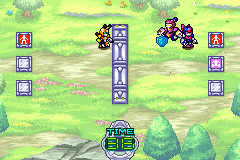
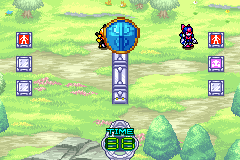
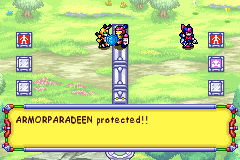
Armorparadeen leaps over to cover Brass……lands at the barrier and raises its shield…“ARMORPARADEEN protected!!”Metabee's missiles hit the guardian instead.
A staged battle: a second opponent, Armorparadeen, was added with its Defence head, and Metabee was set to attack Brass.
The counterattack stance
A part with CntrAttk takes the counterattack stance; its threshold is the part's power. While it holds, attacks on the Medabot hit the stance part (they can't be evaded or guarded), and when the damage is over the threshold the attack is turned round: the attacker becomes the target, and its own attacking part takes the hit From the code.
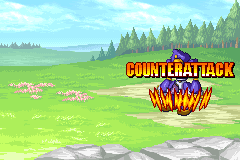
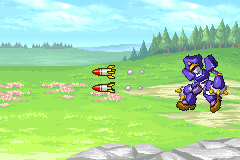
On screen, “COUNTERATTACK” rises over the defender in flames and the attack plays back towards the attacker. A guardian with the Protector Medaforce move counterattacks the same way, on a coin flip.
Metabee fires its head's missiles at Banisher, in the stance.“COUNTERATTACK”.The missiles fly back……and Metabee's head, the part it attacked with, breaks.
A staged battle: Brass was replaced by Banisher, whose parts all have CntrAttk. Counterattacks have been watched, but not compared frame by frame with the original.
Traps
Grap Trap, Shot Trap and Attack Clr lay a trap on the opposing team; setting the same trap again reinforces it with half the values. When a Medabot of that team attacks From the code:
Grap Trap catches Strike and Berserk attacks, Shot Trap Shoot and Aim Shot, and the Anti Attk Trap Medaforce move all four. The attacker's lowest intact part (legs first) takes the trap's strength as damage.
Attack Clr stops the attack instead, and wears down by one use each time.
Break Form removes a trap on your own team; the Cancel Formation move makes a Medabot immune; Formation Orders makes its traps stronger.
Fighting
The Medaforce
The medal's special moves. Fill the gauge to 80 and a medal can use one of its three Medaforce moves, if it has reached the level for it.
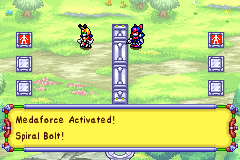
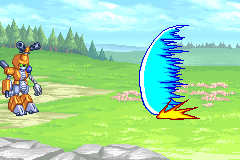
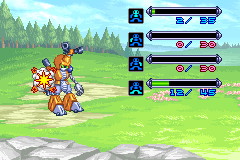
Charge MF: the gauge fills as the Medaforce swirls in.“Medaforce Activated! Spiral Bolt!”Spiral Bolt hits Metabee.The damage panel afterwards.
A staged battle: Brass was given the KUWAGATA medal at level 80 and an always-full gauge.
The gauge
Every Medabot has a Medaforce gauge from 0 to 80Checked.
Every hit it takes fills it by 20, up to 80 (twice as fast under the Medaforce Up move). Getting hit is how you charge it.
Charge MF fills it as an action of its own.
Forcedrain steals Medaforce; Crazy Medaforce takes all the opponents' and turns it into damage.
When a medal can use it
A full gauge (80), and a medal level of at least 10 for the first move, 30 for the second, 60 for the third Checked. Early in the story, opponents can't use the Medaforce at all, so the first rivals never do. The Force Bind skill switches the Medaforce off for everyone (or back on).
How attacking moves hit
success = the move's success + set bonus + a random number from 0 to 7
+ the medal's success for the move's attack type
damage = success ÷ 8 + the move's power
From the code. The Medaforce moves haven't been compared frame by frame with the original yet From the code.
Every move
Fighting
How opponents choose
Opponents don't think: they follow an eight-step pattern written into each battle, the same thing you set up with Rotation.
The pattern
Every opponent has an action pattern of eight steps, one per decision, and a step it loops back to after the eighth Checked. Each step is one of:
Step
Action
Fallback
no decision: use the fallback (below)
Head / right arm / left arm
use that part if it can be used; otherwise the fallback
Nothing
do nothing this time
Medaforce 1 / 2 / 3
use that Medaforce move if it can; otherwise the fallback
The fallback
With a full Medaforce gauge, half the time a random Medaforce move (falling back to a lower move when the medal's level is too low). Otherwise it tries its parts in a random order and uses the first that can be used, or does nothing.
A Medabot under Chaos always uses the fallback, and so does one of yours: you get no menu.
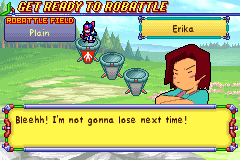
Erika's Brass opens with its head, Scout.
Reading an opponent
An opponent's pattern repeats, so after a few rounds you can tell what it will do next.
Its parts aim the same way yours do, by its medal's favourite attack type (Skills).
After the battle
Rewards and experience
Win and you get experience for every Medabot that fought, and usually one of your opponent's parts.
“The winner is Ikki!”The opponent's parting words.“You earned 237 experience points.”
Winning a part
After a win you get one of your opponents' parts (some story battles turn this off) From the code:
The game rolls 0 to 100 and compares it with 10 for every arm or leg you destroyed on the opponents.
If the roll is no higher, it looks for a part you don't own yet.
Otherwise, or if there's none, you get a random part of a random opponent.
So breaking arms and legs, not just the head, is how you collect new parts. Destroying all six arms and legs of a three-Medabot team gives a 61-in-101 chance of something new Worked out.
Experience
Each of your Medabots in the battle earns From the code:
the opponents' levels ÷ 3
+ 8 for each opponent
+ (their average level − yours) × their number × 16 if their average is higher
+ 16 for every head and 32 for every arm or leg destroyed on them
+ 5 for every TIME second the battle took
+ every opposing part's experience value
Checked once against the game: winning the first story battle after one TIME second gave 237 = 8 (one opponent, level 0) + 224 (Brass's four parts, 56 each) + 5. That's the screenshot above Checked. Long battles pay, and so do strong parts: most of a win's experience is usually the opponents' parts.
Not settled yet Unknown: whether “the opponents' levels ÷ 3” is their total divided by 3, and exactly whose level the average is compared with. The calculator below takes the total, and your Medabot's own level.
Levelling up
The medal needs (new level + 1) × 100 experience for each level, and leftover experience is lost, so a win gives at most one level From the code. At levels 10, 30 and 60 it masters its first, second and third Medaforce move. A medal at level 100 is done.
“"KABUTO" Medal has leveled up!”
Reference
Searchable index
Every Medabot, part, skill, medal and Medaforce move, with the page that explains it.
Reference
Sources and open questions
Where the rules, numbers and pictures on this wiki come from, and what isn't known yet.
The rules
Every rule comes from the Medabots: Metabee decompilation in this repository: the game's code turned back into readable form, function by function. A rule marked Checked was rewritten and run side by side with the original code over real battles, with no differences. The 60 attacking skills were each staged in a battle and checked the same way. From the code means it was read from the code, and often seen on screen, but not compared step by step.
The numbers and names
Part, medal, skill and Medaforce tables, names, leg types and terrains are read from your own copy of the game by the wiki's build script. They're never part of the wiki's source: they're built into public/data/ and public/images/.
The pictures
Battle sprites: decoded from the game's own compressed graphics, six 16×16 pieces per model in the game's palette, and put together the way the battle screen places them.
Screens: taken in the decompilation's native port of the game, which runs the original code and draws exactly what the hardware would. They start from just before the first story battle, Ikki and Metabee against Erika and Brass. The guard, counterattack, status and Medaforce screens come from that battle with the opponent changed, and the win from that battle with Brass taken out partway through.
Not known yet
How a successful guard roll plays out, and what “LEG DEFENSE” marks.
The extra setup step for your own medals' success values.
What the medal's six skill-growth values are for.
How much Charge MF fills the gauge.
Judging when TIME runs out, and a loss's screens, haven't been watched.
The special skills and Medaforce moves haven't been compared frame by frame.
Exactly how the experience formula's level terms are rounded and compared.
What keys do inside the Status and Rotation screens.